
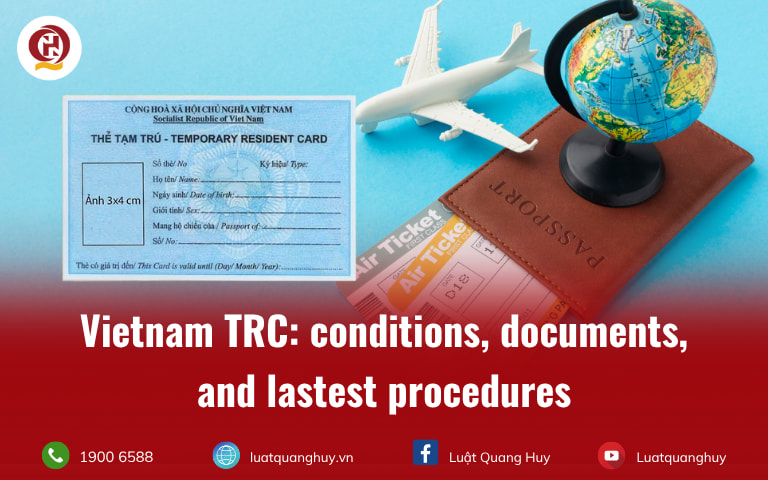
For experts, teachers, investors, or foreigners married to Vietnamese citizens, possessing a Vietnam temporary residence card (TRC) is not just an administrative procedure but a “long-term ticket” offering stability and numerous practical benefits. Compared to short-term visas, the TRC provides absolute peace of mind, allowing the holder to legally reside and work in Vietnam for an extended period, ranging from 1 to 10 years, depending on the purpose and type.
The temporary residence card significantly simplifies the entry and exit process, granting multiple-entry visa exemptions for the duration of the card’s validity, saving considerable time and expense. Furthermore, the TRC facilitates civil activities such as opening bank accounts, registering businesses, and more.
This article will provide an in-depth, comprehensive analysis of the current regulations concerning the Vietnam temporary residence card, updated according to the latest legal documents, including the Law on Entry, Exit, Transit, and Residence of Foreigners in Vietnam and related circulars.
What is a Vietnam temporary residence card for foreigners?
A Temporary Residence Card (TRC) is a legal document issued by Vietnam’s immigration management agencies, including the Immigration Department (Ministry of Public Security) or the Immigration Management Divisions of provincial/municipal police departments. In essence, the temporary residence card is a long-term visa replacement, permitting foreigners to reside legally in Vietnam for a longer duration than a standard visa.
The most significant difference between a Vietnam temporary residence card and a visa is its provision for multiple entries and exits from Vietnam without needing a new visa application during its validity. This is especially beneficial for investors, experts, or businesspeople who frequently travel between Vietnam and other countries. The TRC is not just a residency document; it is a tool that supports a stable life and career in Vietnam with fewer administrative burdens.
Common types of Vietnam temporary residence cards and validity
The issuance of a Vietnam temporary residence card is clearly categorized based on the foreigner’s purpose of entry and residence, with different symbols corresponding to maximum validity periods. Below is a summary table of common TRC types and their maximum validity:
| TRC Type | Eligible Subjects | Maximum Validity |
| ĐT1 | Investors with capital of 100 billion VND or more, or investing in specific favored sectors/areas. | 10 years |
| ĐT2, LV1, LV2, LS, DH, NG3 | Investors with capital from 50 to under 100 billion VND; Experts, high-skilled workers; Lawyers; Students; Members of diplomatic missions. | 5 years |
| ĐT3, NN1, NN2, TT | Investors with capital from 3 to under 50 billion VND; Staff of representative offices, NGOs; Visiting relatives (spouse, child, parent of a Vietnamese citizen or a foreigner with a TRC). | 3 years |
| LĐ1, LĐ2, PV1 | Workers with a Work Permit or Work Permit Exemption; Resident reporters. | 2 years |
| ĐT4 | Investors with capital under 3 billion VND. | 12 months |
Who is eligible to apply for a Vietnam temporary residence card?
To be considered for a Vietnam temporary residence card, foreigners must meet general conditions, such as having a passport valid for at least 13 months, not being subject to exit suspension, and being sponsored by an agency, organization, or individual in Vietnam. Additionally, each specific case must meet separate requirements.
Conditions for experts, teachers (LĐ status)
This group must possess a valid Work Permit or a confirmation of work permit exemption as stipulated by Vietnamese labor law. This is the most critical document proving the legal purpose of work in Vietnam. The sponsoring enterprise or organization in Vietnam is responsible for the employee’s activities. Furthermore, the foreigner must have confirmation of temporary residence registration with the police of the commune or ward where they reside.
Conditions for foreign investors (ĐT status)
Investors must have an Investment Registration Certificate (IRC) or Enterprise Registration Certificate (ERC) that clearly states their capital contribution to the Vietnamese enterprise. The visa currently being used in Vietnam must have the correct symbol corresponding to the investment purpose (e.g., DT). This policy ensures the TRC is issued for its intended purpose, strengthening state management.
Conditions for foreigners married to Vietnamese citizens (TT status)
The prerequisite is a legal Marriage Registration Certificate. If the marriage was registered abroad, the certificate must be consular legalized and translated into Vietnamese as required by law. The Vietnamese spouse will act as the sponsor and must provide personal identification documents such as their Citizen ID card and Certificate of Residence Information to complete the dossier.
Checklist for Vietnam temporary residence card application dossier
Preparing a complete and accurate dossier is the most critical step, determining the success of the application. An invalid or incomplete application may be returned, wasting time and effort, especially if the foreigner’s remaining period of stay is limited.
General dossier for all applicants
Every TRC application dossier must include the following basic documents:
- Application form for temporary residence card (Form NA8).
- Written request (sponsorship letter) from the sponsoring agency/organization (Form NA6) or individual (Form NA7).
- The foreigner’s original passport, valid for at least 13 months.
- A certificate of temporary residence registration issued by the local commune/ward police.
- 02 photos, 2cm x 3cm or 3cm x 4cm, white background, clear face (depending on the specific requirements of the submitting office).
Additional documents by category
In addition to the general documents, applicants must supplement specific materials to prove their legal purpose of residence. Below is a detailed comparison of the necessary documents for common categories:
| TRC Category | Required Documents |
| Labor (Experts, Teachers) | – A valid Work Permit or a written confirmation of work permit exemption. – Legal documents of the sponsoring company (e.g., Business Registration Certificate, Seal Registration Certificate). |
| Investor | Investment Registration Certificate or Enterprise Registration Certificate (notarized copy), clearly showing the capital contribution. |
| Family (Spouse of Vietnamese Citizen) | – Marriage Registration Certificate (notarized copy). If registered abroad: a consular legalized and notarized translation. – Sponsor’s personal identification (Citizen ID card/Household Registration Book). |
Crucially, all documents issued in a foreign language must be consular legalized, translated into Vietnamese, and notarized according to Vietnamese law. A minor error in document preparation or legalization can lead to the dossier being rejected, causing significant delays and costs.
Application procedure for Vietnam temporary residence card
The application process for a Vietnam temporary residence card consists of clear, standardized steps at immigration management agencies nationwide.
- Step 1: Prepare the Dossier The foreigner and the sponsoring entity/individual prepare all necessary documents according to the corresponding residence category.
- Step 2: Submit the Dossier The dossier can be submitted in one of the following ways:
- In-person: At the Immigration Department (Ministry of Public Security) or the Immigration Management Division of the provincial/municipal police where the foreigner is temporarily residing.
- Online: Via one of the two following portals:
- National Public Service Portal: https://dichvucong.gov.vn/
- Ministry of Public Security Public Service Portal: https://dichvucong.bocongan.gov.vn/
- Step 3: Dossier Reception and Processing The receiving officer checks the validity and completeness of the documents. If the dossier is eligible, the agency will issue an appointment letter for the result and collect the fee. If the dossier is incomplete or invalid, the applicant will be guided to supplement it. For ineligible applications, the agency will issue a written refusal stating the reason.
- Step 4: Receive the Result The result will be returned on the date specified in the appointment letter. When collecting the card, the applicant must bring the appointment letter, fee receipt, and personal identification for verification.
How long does it take and How much does it cost?
Timeframe for TRC application
By regulation, the processing time for a Vietnam temporary residence card application is 05 working days from the date of receiving a complete and valid dossier. Some sources indicate it may take longer, around 07 working days, especially if the dossier requires further verification.
Cost of TRC application
The state fee for issuing a temporary residence card is stipulated in Circular 25/2021/TT-BTC by the Ministry of Finance and is collected in USD or converted to VND at the exchange rate at the time of payment.
| TRC Validity | State Fee |
| Not exceeding 2 years | 145 USD/card |
| Over 2 to 5 years | 155 USD/card |
| Over 5 to 10 years | 165 USD/card |
Frequently asked questions (FAQ)
- If I have a temporary residence card, do I still need a visa?
No. The Vietnam temporary residence card (TRC) functions as a long-term visa replacement. During the card’s validity, the foreigner can enter and exit Vietnam multiple times without needing to apply for a new visa.
2. Does a temporary residence card permit legal work?
The TRC only confirms the right of residence. To work legally in Vietnam, the foreigner must still possess a Work Permit or fall under the category of work permit exemption as stipulated by labor laws.
3. What should I do when my temporary residence card expires?
To avoid administrative penalties for overstaying, the foreigner must complete procedures for extension or issuance of a new card at least 05 working days before the expiry date. Failure to do so may result in fines or forced exit.
4. Can a lost temporary residence card be reissued?
Yes. If you lose your TRC, the first step is to report it to the local police to obtain a “Confirmation of Loss” certificate. Afterward, the foreigner can proceed with the application for a new temporary residence card at the Immigration Management Agency.
5. Can I convert my visa purpose to apply for a temporary residence card?
According to regulations, a foreigner can change their purpose of entry to apply for a TRC if they have valid supporting documents. For example, converting from a Tourist visa (DL) to a Labor visa (LD) upon receiving a Work Permit or a WPE confirmation.
The Vietnam temporary residence card is the “key” for foreigners to live and work in Vietnam with peace of mind; however, the administrative procedures can be highly complex and fraught with potential risks. The Vietnamese legal system is continuously amended and supplemented, leading to changes in forms and processes. Failure to update on these changes or preparing an incomplete or invalid dossier can lead to rejection, costing time, money, and severely impacting work and investment schedules.
Furthermore, the “do-it-yourself” process can present many challenges, from gathering the sponsoring company’s legal documents to the consular legalization of foreign documents, or even a minor error in filling out a form. Instead of facing these risks and complexities alone, engaging a professional legal service is the optimal solution.
To save time, optimize costs, and mitigate all legal risks, let Quang Huy Law accompany you. With many years of experience in the field of immigration and residence, Quang Huy Law has successfully assisted clients including experts, teachers, investors, and foreigners married to Vietnamese citizens.


